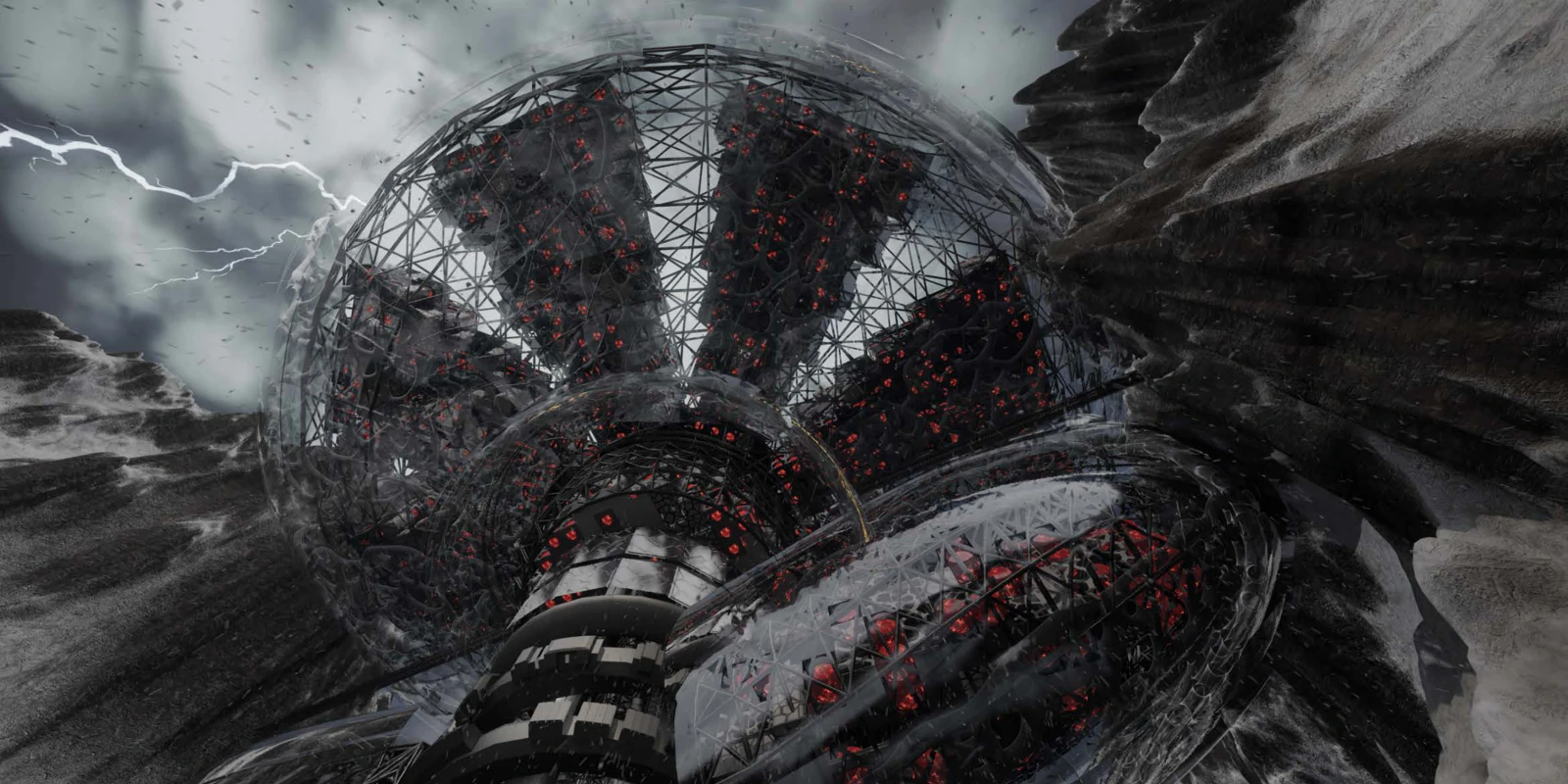
Emergency Refuge
Download original PDF04 / Project overview
← All projectsInspired by the “Younger Dryas Impact Hypothesis”, this project combines Grasshopper parametric design techniques with plant system biomimicry to create a sustainable, highly continuous, and adaptable emergency shelter system in extreme cold environments, addressing the challenges of resource depletion and extreme climate in the future. Intended to utilize Grasshopper and procedural generation from game design to rethink new methods of organizing and utilizing architecture and urban systems.
BACKGROUNDCONCEPT~18,000 yr BPLAST DEGLACIAL~12,000 yr BPYOUNGER DRYAS EVENTPRESENT+100 yrGLOBAL WARMING+500 yrGLACIAL PERIOD+1000 yrERA of FROST RIFTAtlantic Meridional Overturning Circulation (AMOC)Increased heat from the oceans due to global warming, coupled with the melting of the Arctic ice caps and increased freshwater inflow to the oceans, would weaken the AMOC.
Eventually led to the collapse of the AMOC, sending North America, Europe, and even the world into an era of extreme cold.DryasWFCThe fundamental structural and functional unit of life.The genetic material within cells that controls inheritance and directs cellular functions.Processes by which cells replicate and transform into specialized types, forming distinct plant organs.Specialized structures, like roots, stems, and leaves, that carry out specific functions within the plant.The basic units or elements used to build the structure.Constraints that define the relationships between adjacent modules.The spread of information under local constraints throughout the structure.The final pattern generated by following the rules.The operation logic of wave function collapse (WFC) is very similar to the growth logic of plants. Such a procedural generation method allows the survival activities and behaviors of human society to extend and cycle in the limited scope of the whole system.ERA of FROST RIFTresource-poorcoldthreateningEMERGENCYSURVIVAL is
the first priority!gathered
continuous
adaptableWFCEnergy systemBasic function
of building① Cells ② DNA ③ Cell Division and Differentiation ④ Plant Organ ⑤ Plantⓐ Modules ⓑ Rules ⓒ Propagation ⓓ Solution ⓔ Aggregation
SYSTEMIC BIOMIMICRYFlowerEnergy SystemMegastructureSolar TowerEnergy CenterMaglev ElevatorUnderground PipesRootsLeafStemSepalsPetalsSupplies ProductionFood ProductionHeliostat❶❶Cup-shaped, helping to gather air and light within the flower,keeping the ovary warm.❷Reflecting sunlight towards the center of the flower, which is thepistil.❷During the day, heliostats focus sunlight onto the solar tower, where molten salt absorbs andstores thermal energy.At night or on cloudy days, the salt releases the energy, driving the generator for 24-hourelectricity production.Ⅰ.Ⅱ.Ⅲ.Ⅳ.A.B.C.D.❸Reducing heat loss to ensure it opens inextreme conditions.❹Supporting the petals, keeping the flowerstable and aiding pollination.❼Carry out photosynthesis:absorbing sunlight andconverting it into energy .Chloroplasts in the leavesabsorb light energy, usingcarbon dioxide and water toproduce organic compoundsand release oxygen.❽Their small, dense shapeminimizes damage from windand snow while improvingsunlight absorption.❾Absorb water and nutrients from the soil. ❿Provide stability, preventing displacement due to weather.❺It has hairy structurethat help reduce waterloss and providesadditional insulation.❻It supports the plantupright, ensuring theleaves and flowersreceive maximumsunlight.ⓐⓑMolten salt energy storage unitefficiently stores energy, with theenergy center carried for shelterin emergencies, ensuring energyavailability.Energy conversion and real-timemonitoring maintain system stability,ensuring optimal energy usage.ⓒⓓThe center features a verticallyintegrated transportation system,primarily using magnetic levitationelevators.The sides are designated for foodand material production spaces.Maximizes the use of underground energy.Saves energy for the low-temperature storage of liquid nitrogen, enhancing efficiency.ⓔⓕⓖⓗDryas is capable of surviving in extreme cold andmountainous environments, owing to its uniqueadaptive biological structure that allows it to thrive inharsh conditions. Through its integrated energy system,including efficient energy utilization and recyclingmechanisms, the plant adapts to extreme environments.Insights derived from the biological characteristics andenergy management strategies developed through itslong-term evolutionary process offer valuable guidance forthe design of energy systems in new settlements.Solar EnergyMolten Salt Energy
Storage SystemHeatBackup sourceLiving & FacilitiesElectricityLiving & FacilitiesAir Compression
Air Cooling
Liquefaction process
Adiabatic transportationLiquid NitrogenLiquid Nitrogen Cooling SystemReduced cooling energy
consumption due to
cold environmentHigh-Temperature SuperconductorMaglev ElevatorUnderground EnergyEnergy generationEnergy consumptionReuseReduce
Typed RulesSlots and ModulesMain input data types: Slots,Modulesand Rules. These inputs are essential andnecessary for WFC algorithm to generateasolution.SlotsSlot is a cuboid (orthogonal box) thatrepresents the basic unit of the Monocerosrigid discrete grid.ModulesModule is a unit, which is being distributedoverthe specified Envelope. The purpose ofa Monoceros Module is to place predefinedgeometry into dedicated Slots.RulesThe rule is a distinct data type describingadjacency of two Modules by aligning theirConnectors facing opposite direction.ELEMENTS OF WFC ALGORITHM INPUTSC-01P-01G-01E-03G-05T-01T-09T-05L-01L-05C-05C-09C-13C-17C-21C-25E-04G-02G-06T-02T-10T-06P-02L-06L-02C-10C-18C-26C-22C-14C-06C-02E-01E-05G-03T-03T-11T-07P-03L-07L-03C-11C-27C-23C-19C-15C-07C-03E-02E-06G-04T-04T-12T-08P-04L-08L-04C-12C-28C-24C-20C-16C-08C-04*All modules are operated in a 4x4x4 framework*Empty module: It is possible that the Modules cannot be stacked together without leaving blank Slots, which is considered a contradictory and therefore invalid result. WFC solver needs to fill every slot. Empty module is therefore often necessary.*Typed Rules: List of allowed neighbor modules for each module in each direction.*lndifferent connection: A module with no explicit connection in certain direction is indifferent in that direction and can connect to any module indifferent in the opposite direction.*Explicit rule: Single rule explicitly allowing two modules to be neighbors in the specified direction. Just like any other Rule, Typed or Explicit, also the Indifferent Rule can be assigned to a Connector that already is described by another Rule. lt can also be used as a disallowed Rule with the Collect Rules component.Residential SlotCentral control SlotProduction SlotType AType DType EType GType BType CType AType BType AType FType BCubesLiftsPlatformTracksGardensEmpty ModulesPetalSepalLeafType AType AType AType BType BType CType CType DType DType EType F4xyz44Indifferent connections caninterconnect with each other.Explicit Rules Disallowedexample: C-01 & C-11example: P-03 & P-01example: P-01 & P-03example: T-01 & G-05example: P-01 & P-01example: P-01 & P-03Exceptfor:For example:➟➟➟➟➟➟
EXPERIMENTS WITH BASIC MODULESInput1217slots166 typed rules592 rules indifferent228 explicit rules disallowed30297 rulesMonoceros WFC Solver found a solution.Data preprocessing: 97msWFC Solver: 439707msWFC Pre & Post-processing: 7223msWFC Attempts: 432484ms; Fastest: 250ms;Slowest: 10643msRule count: 30395Part count: 145Slot count (including outer Slots): 5520Solution random seed: 2000209495Solve attempts: 124Approach to entropy calculation: linearSolver observations limited to: 4294967295Observations required to find the solution: 588Average observation count per attempt: 4Input640slots132 typed rules488 rules indifferent116 explicit rules disallowed20942 rulesMonoceros WFC Solver found a solution.Data preprocessing: 60msWFC Solver: 8358msWFC Pre & Post-processing: 2442msWFC Attempts: 5916ms; Fastest: 1147ms;Slowest: 3184msRule count: 21033Part count: 123Slot count (including outer Slots): 1680Solution random seed: 470454661Solve attempts: 3Approach to entropy calculation: linearSolver observations limited to: 4294967295Observations required to find the solution: 305Average observation count per attempt: 101304 slots116 typed rules428 rules indifferent138 explicit rules disallowed16000 rulesMonoceros WFC Solver found a solution.Data preprocessing: 52msWFC Solver: 2458msWFC Pre & Post-processing: 936msWFC Attempts: 1522ms; Fastest: 521ms; Slowest: 1001msRule count: 16063Part count: 103Slot count (including outer Slots): 1224Solution random seed: 1912463980Solve attempts: 2Approach to entropy calculation: linearSolver observations limited to: 4294967295Observations required to find the solution: 158Average observation count per attempt: 79171471013161Petals' slotSepals' slotLeaves' slot133691513122514172811UtilizationBalanceLogicalityUtilizationBalanceLogicalityUtilizationBalanceLogicalityUtilizationBalanceLogicalityUtilizationBalanceLogicalityUtilizationBalanceLogicalityUtilizationBalanceLogicalityUtilizationBalanceLogicalityUtilizationBalanceLogicalityUtilizationBalanceLogicalityUtilizationBalanceLogicalityUtilizationBalanceLogicalityUtilizationBalanceLogicalityUtilizationBalanceLogicalityUtilizationBalanceLogicalityUtilizationBalanceLogicalityUtilizationBalanceLogicalityUtilizationBalanceLogicalityUtilizationBalanceLogicalityUtilizationBalanceLogicalityUtilizationBalanceLogicalityTransportation ModulesTransportation ModulesTransportation ModulesFunctional ModulesFunctional ModulesFunctional ModulesEmpty ModulesEmpty ModulesEmpty Modules
DEVELOPED MODULESPetals' ModulesSepals' ModulesLeaves' ModulesCommon ModulesFacilitices5% of the slot,max capacity: 16 people,generated by Cube Type AEnvironmental monitoring3% of the slot,generated by Cube Type AApartment7% of the slot,max capacity: 4 people,generated by Cube Type FEnrgy monitoring9% of the slot,generated by Cube Type DEnrgy monitoring9% of the slot,generated by Cube Type FResource production7% of the slot,generated by Cube Type FAnimal cultivation7% of the slot,generated by Cube Type DAnimal cultivation7% of the slot,generated by Cube Type EPlant cultivation7% of the slot,generated by Cube Type BPlant cultivation7% of the slot,generated by Cube Type CResource production15% of the slot,generated by Cube Type GResourceallocation control20% of the slot,generated by Cube Type GEnrgy monitoring9% of the slot,generated by Cube Type EApartment7% of the slot,max capacity: 4 people,generated by Cube Type DApartment7% of the slot,max capacity: 4 people,generated by Cube Type EApartment7% of the slot,max capacity: 4 people,generated by Cube Type Bgenerated by Garden Type Agenerated by Platform Type Agenerated by Track Type Cgenerated by Track Type Agenerated by Track Type Bgenerated by Empty Modulesgenerated by Track Type Dgenerated by Lift Type Agenerated by Lift Type Bgenerated by Garden Type BApartment7% of the slot,max capacity: 4 people,generated by Cube Type CApartment10% of the slot,max capacity: 2 people,generated by Cube Type G
SLOTS’ PLANSEXPLOSION ANALYSIS of CONSTRUCTION① Solar Tower & NanostructuredOptical Metamaterial EnvelopeThe outer membrane reflects sunlightonto the central solar tower, wherephotovoltaic systems and thermalcollectors convert it into usable power.The membrane's precise controlof reflectivity, color, and refractionenhances solar energy capture. Itssuperhydrophobic surface prevents snowaccumulation, ensuring uninterruptedlight reflection and maintainingfunctionality even in extreme cold.0m50m100m150m200m② Nanofiber Composite AerogelStructuresThe nanofiber composite aerogelstructure offers structural support, self-cleaning, and frost resistance. It formsa biomimetic mesh protective layer,creating a double skin for buildingunits, enhancing thermal insulation andprotection from harsh conditions.③ Nanostructured OpticalMetamaterial Inner LayerThe inner membrane, bonded tonanofiber composite aerogel, adaptstransparency to optimize light and reduceenergy loss. It allows natural light byday and retains heat at night or in coldconditions, enhancing energy efficiencywhile regulating heat transfer for indoorcomfort with minimal heating reliance.④ Supported Truss StructureThe outer shell serves primarily as astructural support, with a truss systemthat extends into the adjacent mountaincliff, anchoring the building andenhancing stability. This design ensuresboth the strength and resilience of thefacade while integrating the structureseamlessly with its environment.ENVIRONMENTAL RESPONSE STRATEGY12a.m.9a.m.3p.m.The nanophotonic metamaterial outer membrane can adjust its angle and modify parameters such as reflectivityand refractive properties in response to changing light conditions, optimizing sunlight capture and energy efficiencythroughout the day.A. HospitalsB. SchoolsC. ChurchesD. Entertainment facilitiesE. Energy monitoring roomF. Environmentalmonitoring roomG. Resource allocationcontrol roomH. Plant cultivation roomI. Animal cultivation roomJ. Resource production room0 20m 40m 60m 80m0 20m 40m 60m 80m0 20m 40m 60m 80mEach section contains basic residential, transportation, andenergy storage areas. Additionally, every two symmetrical petalsshare the same type of infrastructure, includingThe energy slot functions as the central control hub for the entiresettlement.The production area is primarily responsible for manufacturingand recycling.
OVERALL BIRD'S-EYE VIEWENERGY ZONE SCENARIOVERTICAL ELEVATOR SCENARIORESIDENTIAL ZONE SCENARIO